
Employee Advocacy Program: Why Your Best Influencers Are Already On Your Payroll
Discover how employee advocacy programs turn employees into trusted brand voices, expand LinkedIn reach, build credibility, and drive organic growth.
Your employees post on LinkedIn anyway. The question is whether that's working for your brand or just... happening.
That's the whole idea behind employee advocacy. And in 2026, it's stopped being a "nice to have" for forward-thinking marketing teams. It's becoming the thing that actually moves the needle when paid ads get more expensive and organic reach for company pages keeps shrinking.
Let's break down what employee advocacy actually is, why it works so well right now, and how a real program looks in practice (including a case study where Brandlifts founder Anastasiia Yashchenko helped Semrush hit 9M+ organic impressions without spending a cent on ads).
What Is Employee Advocacy, Really?
Employee advocacy is when your employees share brand-related content on their own social profiles — usually LinkedIn — using their own voice.
Not corporate copy-paste. Not forced reposts. Real people, sharing real insights, tagged with your brand somewhere in the mix.
Think of it this way: a company page post might reach a few hundred people. That same message, shared by 20 employees, reaches their combined networks — which is often 10x, 50x, sometimes 100x bigger. And it lands differently, because it's coming from a human, not a logo.
Employee Advocacy vs. Influencer Marketing
People mix these up a lot, so let's clear it up quickly.
Influencer marketing pays external creators to talk about your brand. Employee advocacy activates people who already work for you — no fee, no negotiation, no contract renewal every quarter.
The trust factor is different too. According to research cited by Edelman and others for years running, people trust employees' opinions about a company far more than they trust the company's own marketing. Employees aren't seen as "selling" something. They're seen as sharing what they actually know.
Why Employee Advocacy Matters More in 2026 Than It Did Five Years Ago
A few things changed, and together they make employee advocacy less optional than it used to be.
Organic Reach for Brand Pages Keeps Dropping
LinkedIn, like every platform, prioritizes personal profiles over company pages in the algorithm. A post from a company page might get seen by 2-3% of followers. A post from a personal profile with strong engagement can reach far beyond someone's own follower count.
If you're only posting from your brand page, you're leaving reach on the table. A lot of it.
Buyers Don't Trust Ads Like They Used To
B2B buyers are doing more research before they ever talk to sales. They're checking LinkedIn. They're looking at who works at the company. They're forming an opinion based on what they see from real employees — not just the brand's polished messaging.
If your employees are visible, knowledgeable, and active, that builds trust before a single sales call happens.
It's One of the Few Truly Zero-Cost Growth Channels Left
Paid social costs keep climbing. Employee advocacy doesn't need a media budget. You're not paying for impressions — you're unlocking reach that already exists inside your organization.
Talent Wants to Work at Visible Companies
This is the part people forget. A strong employee advocacy program doesn't just drive leads. It also makes your company more attractive to future hires, because candidates can see real employees talking about real work, not a stock-photo careers page.
Get a free consultation with Brandlifts.
How Employee Advocacy Actually Works
Here's where a lot of programs fall apart — companies ask employees to "post more" without giving them a system. That doesn't work. People are busy, unsure what to say, or worried about sounding too promotional.
A real program needs structure. Here's the process we run at Brandlifts, broken into seven steps.
Step 1: Onboarding
Before anyone posts anything, you need buy-in. This step is about onboarding brand advocate volunteers into the program structure and goals, so everyone understands what they're signing up for and why it matters.
No one should feel forced into this. The best advocates are the ones who actually want to build a presence.
Step 2: Education
Most employees aren't ignoring LinkedIn on purpose — they just don't know where to start. This step covers live sessions to educate and introduce volunteers to LinkedIn growth strategies.
This is where you demystify the algorithm, talk through what makes a post actually get seen, and get people comfortable showing up online.
Step 3: Content
This is the part employees care about most: what do I actually post?
We handle this with weekly, ready-to-share, high-performing content delivered to all advocates. No blank page anxiety. No "what should I say today." Just content that's already been shaped to perform, ready for each employee to personalize and post.
Step 4: Tools
Posting shouldn't be a hassle. Management tools are made available for brand advocates to post and track their content easily, so there's no friction between "I have something to share" and "it's live."
Step 5: Training
This isn't a one-time thing. Weekly training materials help employees build personal brands on LinkedIn on an ongoing basis, because personal branding is a skill that develops over time, not overnight.
Step 6: Scale
Once the early advocates are seeing results, it's time to grow. This step is about launching and managing your advocacy program at scale across the organization — bringing in more employees, more departments, more voices.
Step 7: Optimise
Nothing gets left on autopilot. This means tracking performance and optimizing engagement across the full program, so you know what's working, what's not, and where to double down.
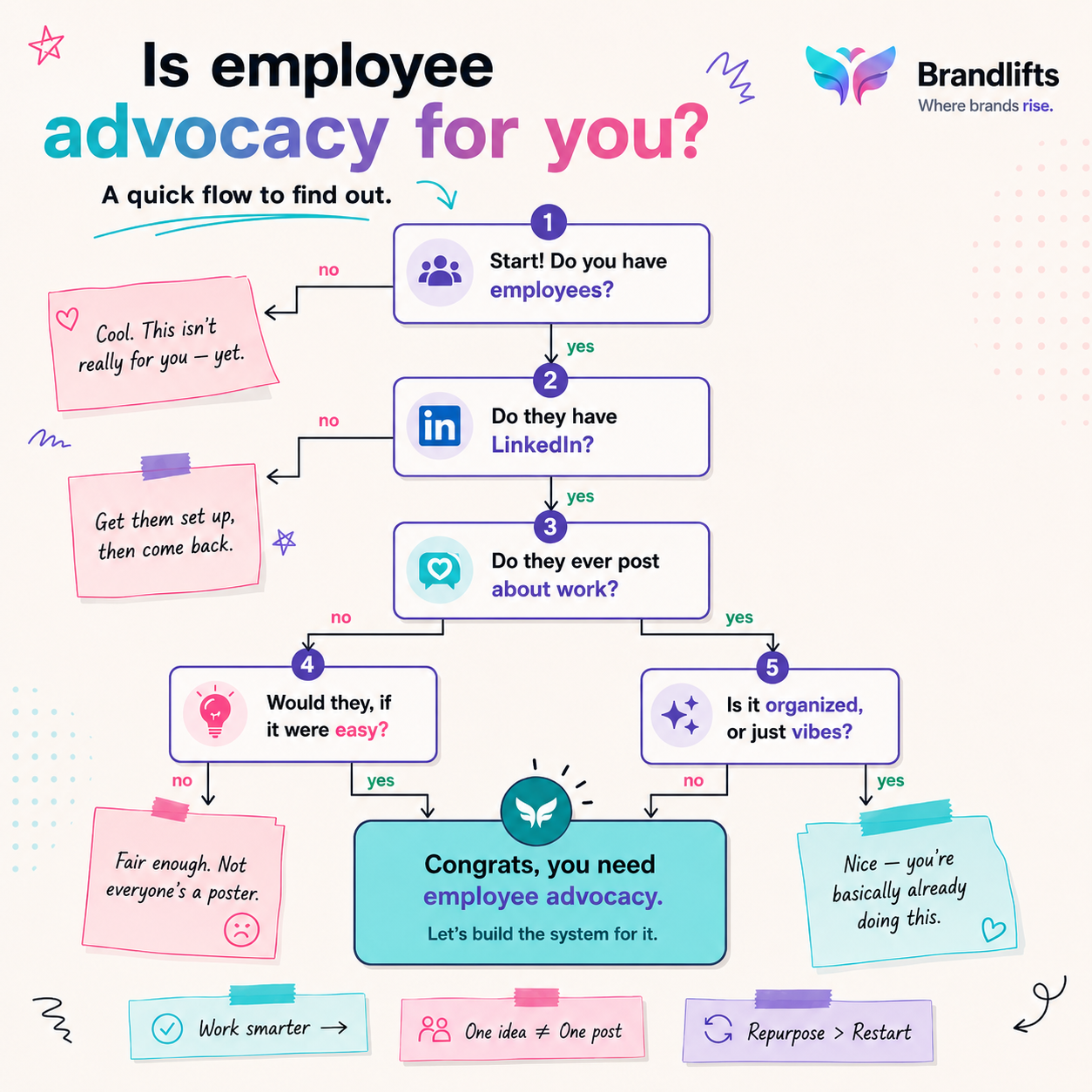
A Real Example: How Semrush Built an Employee Advocacy Program From Scratch
Talking about theory is one thing. Here's what this actually looked like:
Platform: LinkedIn
Objective: Build organic reach through employee-generated content, drive website traffic, and grow Semrush's LinkedIn presence — with zero paid spend.
What Was Done:
The program was led by Brandlifts founder Anastasiia Yashchenko, who built the strategy around getting real Semrush employees comfortable and consistent on LinkedIn.
Her role covered the full loop: program design, employee-generated content (EGC) creation and distribution, weekly analytics and reporting, an incentives program to keep advocates motivated, and LinkedIn learning materials to build everyone's skills over time.
The Results
The numbers speak for themselves:
- 9M+ total organic impressions through employee-generated content
- +20% increase in website traffic
- 6 months to measurable business impact
- €0 paid spend — purely organic
No ad budget. No influencer fees. Just employees, equipped with the right content and training, sharing consistently.
Common Mistakes Companies Make With Employee Advocacy
Since we're deep in the weeds here, let's cover what goes wrong when programs fail — so you can avoid it.
-
Making It Mandatory
Forced posting reads as forced. It usually sounds robotic, and employees resent it. Volunteers who actually want to build their presence will always outperform people posting under pressure.
-
No Content Support
If employees have to come up with what to post every single week, the program dies fast. That's why the content step matters so much — you need a steady, ready-to-use content pipeline.
-
No Tracking
If you can't see what's working, you can't improve it. Programs need weekly reporting, not vague hopes that "it's probably helping."
-
Treating It as a One-Time Push
A single onboarding session isn't a program. It's an event. Real advocacy needs ongoing training, fresh content, and long-term momentum.
Getting Started With Employee Advocacy
If you're thinking about building this for your company, the good news is you don't need to figure it out from zero. We've run this exact playbook — the same seven-step structure that helped Semrush hit 9M+ impressions — for multiple B2B brands.
The bad news? Doing it well takes real strategy, consistent content production, and someone watching the numbers every week. It's not something you can bolt on as a side project.
That's exactly what we do at Brandlifts.
Ready to Build Your Own Employee Advocacy Program?
If you're curious what this could look like for your team, let's talk it through. We'll walk you through the strategy, show you how the seven-step process would apply to your company, and map out what results could realistically look like.
Get a free consultation with Brandlifts.
No pressure, no generic pitch deck — just a real conversation about whether employee advocacy makes sense for where you are right now.